
Sustainability as an Educational Mission: KIT is a Place of Learning for a Sustainable and Resilient Future
In its teaching, KIT combines academic excellence with an exploration of how knowledge can contribute to the responsible shaping of social, technological, and ecological transformations. Sustainability-related subject matter, interdisciplinary key competencies, and practice-oriented learning methods are closely intertwined.
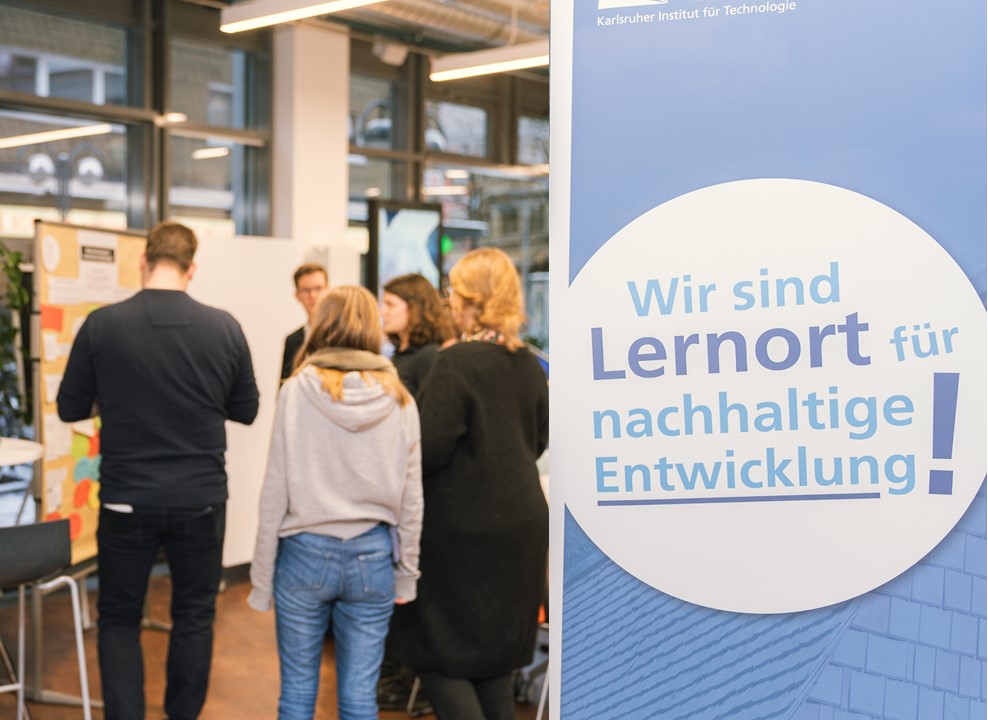
For its wide range of programs in Education for Sustainable Development (ESD), KIT was honored as a “Places for ESD” at the 2022 National ESD Award.
Strategic Integration and Participatory Development
With the KIT 2025 Strategy and the creation of an Executive Board Department for Digitalization and Sustainability (2023), KIT has strategically and institutionally anchored sustainability. Programs for sustainability education and Education for Sustainable Development (ESD) are being continuously developed. For example, as part of the “Higher Education” work package of the Basis Project Sustainability (2023–2025), structures and implementation concepts were developed through a participatory process and approved by the Executive Board; these are now being implemented step by step.
Academic Training: Research-Based Teaching
KIT equips students with the skills they need through subject-specific and research-oriented teaching that integrates sustainability as a cross-cutting topic. Degree programs combine disciplinary knowledge with the Sustainable Development Goals (SDGs). This specialized knowledge can then be applied to develop sustainable and resilient solutions.
Pilot projects in three KIT Departments and the Center for Teacher Education (ZLB) are testing measures to further embed sustainable development and ESD in the teaching curriculum.
Future Skills for Lifelong Learning
Interdisciplinary key competencies such as systemic thinking, as well as the ability to reflect and exercise judgment, enable students to grasp complex sustainability challenges, incorporate different perspectives, and weigh conflicting goals. Interdisciplinary and transdisciplinary formats—such as extracurricular and co-curricular programs—help students critically analyze scientific, technological, and societal developments.
Public educational offers also create spaces for reflection, exchange, and lifelong learning, and open KIT as a place of learning to diverse target groups.
Transformation Competence: Reality Labs and Public Learning Opportunities
KIT uses its large-scale research infrastructures and real world labratories as hands-on learning and experimentation spaces where real-world sustainability challenges are addressed and potential solutions are tested.
Co-teaching formats, in particular, supplement courses in the natural sciences and engineering by incorporating sustainability-related perspectives and skill-building modules. This helps students actively and responsibly shape processes of change.
Unique Selling Point: Systemic and Transdisciplinary Teaching
As a university of excellence with a major national research facility, KIT combines cutting-edge scientific research and high-tech infrastructure with collaborative learning. Through international and intercultural projects as well as transformational skills, students are empowered to actively shape a future of sustainability. The integrative combination of in-depth subject knowledge, key and transformational competencies, and inter- and transdisciplinary perspectives helps students understand complex sustainability challenges and translate knowledge into responsible action. With its “Science for Impact” vision, KIT positions itself as a pioneer in transformative education—scientifically grounded, practice-oriented, and socially relevant.
Here you find an overview of the courses on education for sustainable development offered at KIT.
↵Accompanying studies, certificates and other offers at KIT
- General studies
- Supplementary sustainable development studies
- Certificate in Sustainable Development
- Spring Academy of Sustainability
- Academy for Responsible Research, Teaching, and Innovation (ARRTI)
- Perspectives Laboratory [in German]
- Additional qualification in Education for Sustainable Development for teaching degree students [in German]
- Karlsruhe School of Sustainability (KSN)
- MobiLab - mobile venue for transformative education
- Karlsruhe Transformation Center for Sustainability and Cultural Change (KAT)
- Green CAMPUS Office [in German]
- Center for Advanced Technological and Environmental Training (FTU) with House of Little Scientists [in German]
- University groups - offers relating to ESD [in German]
- Academic Leadership - leadership in science
- LeNa Shape - social responsibility researc
- Places of learning at KIT
Graduate programs with a focus on sustainability
- KIT Graduate School GRACE – Graduate School for Climate and Environment
- KIT Graduate School Enabling NetZero (ENZo)
- KIT Graduate School Cultures of Knowledge (CuKnow)